macOS authd Flaw (CVE-2026-112430): Public Exploit Turns a Wrong Password Into Root. Update Now
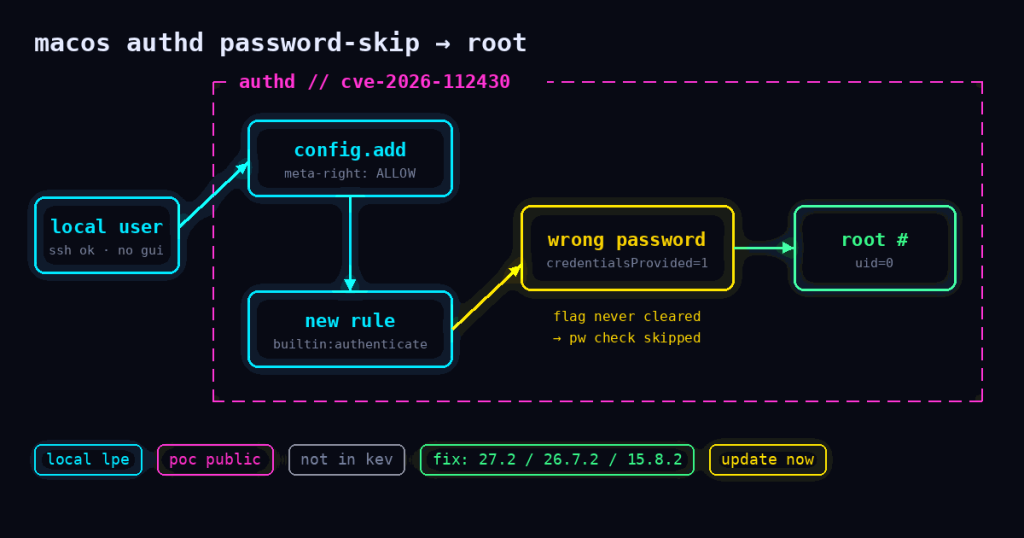
A security researcher has published working exploit code for a macOS privilege-escalation bug that turns one of the operating system’s core security services against itself. The flaw, tracked as CVE-2026-112430, sits in authd, the background daemon that decides whether a user or app is allowed to perform privileged actions. Exploited, it hands an ordinary local account root, the highest level of access on the machine, without ever needing the administrator password.
Apple patched the bug on October 26 in macOS Golden Gate 27.2, macOS Tahoe 26.7.2 and macOS Sequoia 15.8.2. Any Mac running an earlier build of those versions is vulnerable, and with exploit code now on GitHub, the barrier to abusing it has dropped to roughly zero.
What Apple said
Apple’s advisory was characteristically brief. The company described the problem as “an authentication issue” that it “addressed with improved validation of user attributes,” and warned that “an app may be able to gain root privileges.” The bug was one of several root-level flaws in macOS’s Security component that Apple fixed in the same release, alongside CVE-2026-112668, CVE-2026-86936, CVE-2026-112437 and CVE-2026-112434, according to a Center for Internet Security advisory.
The National Vulnerability Database rates the flaw 7.8 (High) on the CVSS 3.1 scale, scoring it as a local attack with low complexity that needs only low privileges and no user interaction. The researcher’s own write-up puts it at 8.4.
How the attack works
The researcher’s analysis, released this week, shows that the problem is a logic error in how authd tracks whether a password has been checked, not a memory-corruption bug. That makes the exploit reliable: it works every time rather than depending on winning a race or guessing memory addresses.
In plain terms, the chain has two parts:
- Anyone could write a new rule. macOS keeps an authorization database of “rights” that define what it takes to perform a privileged action. A meta-right called
config.addwas set to allow anyone to add new rules. An attacker could register a rule whose only requirement was a single built-in authentication step. - The password check could be skipped. When a client submitted credentials, authd set an internal “credentials provided” flag before verifying the password, and never cleared it when the check failed. Because the flag stayed set, authd’s evaluation loop treated the authentication step as already satisfied and skipped the real password verification. According to the write-up, simply entering a wrong password was enough to leave the flag set.
The result is an administrator-level authorization granted with no valid password, which the published exploit then turns into a root shell. The proof of concept, posted to GitHub as “authd_nday,” consists of a shell script and a C exploit.
The attack does not need the Mac’s graphical interface. A user logged in remotely over SSH can run it just as easily, which makes it especially relevant for shared Macs, lab machines, build servers and any Mac with Remote Login turned on.
How worried should you be?
The bug is local-only, so an attacker has to be able to run code on the Mac first, whether through a malicious app, a stolen user account or a foothold gained some other way. On its own it cannot be used to break into a Mac over the internet.
Bugs like this are exactly what attackers chain together, though. A piece of malware that lands with ordinary user rights, or an intruder holding a low-privilege SSH login, can use a reliable root exploit to disable protections, install persistent backdoors and read every user’s data.
So far, there is no confirmed exploitation in the wild, and the flaw is not on CISA’s Known Exploited Vulnerabilities list. Its EPSS score, a model that estimates the chance of exploitation within 30 days, was about 0.2% when the CVE was published. That figure predates the public exploit, and public, deterministic proofs of concept tend to get folded into attacker toolkits quickly.
This isn’t the first time authd has been the weak link. In 2020, researcher Ilias Morad’s “Unauthd” chain (CVE-2020-9854) also started with a flaw in authd and escalated all the way to the kernel.
What to do
- Update now. Install macOS Golden Gate 27.2, Tahoe 26.7.2 or Sequoia 15.8.2 or later. Check under Apple menu → About This Mac, or run
sw_versin Terminal. - Admins: enforce the update through MDM. Look for Macs that are behind on patches, especially shared and headless machines.
- Turn off Remote Login where it isn’t needed. That shrinks the pool of accounts that can reach the bug over SSH.
- Watch the authorization database. Unexpected changes to authorization rights, such as new rules added through
config.add, deserve a closer look on machines that may have been exposed before patching.
Apple has not commented on the release of the proof-of-concept code.
Sources: Apple: About the security content of macOS Tahoe 26.7.2; NVD: CVE-2026-112430; Center for Internet Security Advisory 2026-121; OpenCVE; Objective-See: “Unauthd” (CVE-2020-9854).