NFS2ROOT (CVE-2026-99362): Critical Linux NFS Server Bug Gives Remote Root. Patch Now
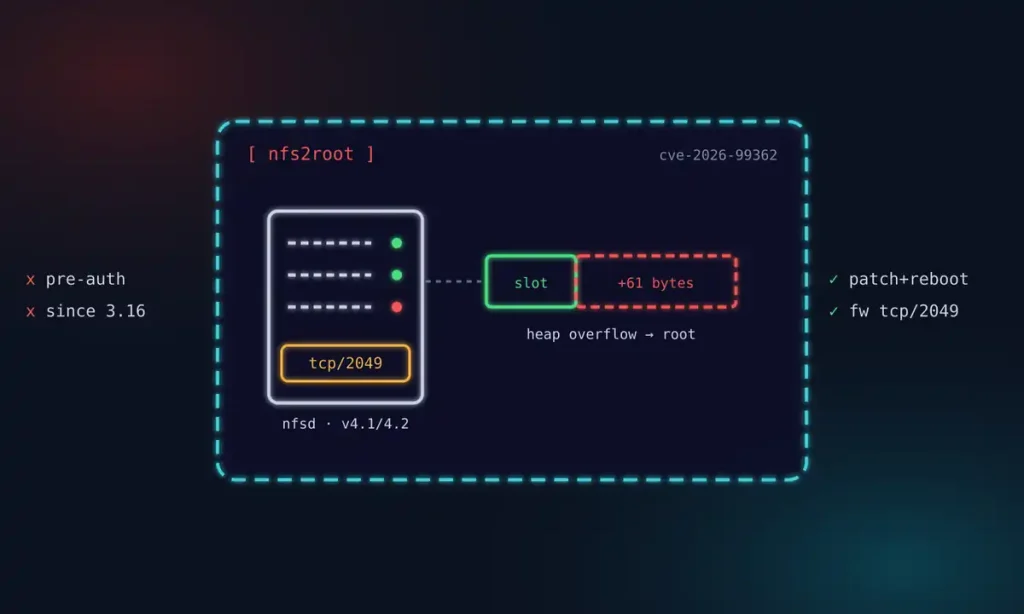
If you run a Linux box that shares folders over NFS, and in a homelab that’s a lot of us, stop what you’re doing. CVE-2026-99362, nicknamed NFS2ROOT, is a critical bug in the Linux kernel’s built-in NFS server that lets someone who can reach port 2049 corrupt kernel memory without logging in. Researchers have turned it into a working remote root exploit in the lab.
The short version
- What: An out-of-bounds write (heap overflow) in
nfsd, the kernel’s NFS server - Severity: 9.8 Critical (CVSS 3.1, Red Hat’s rating)
- Who’s affected: Servers exporting NFSv4.1 or NFSv4.2 on an unpatched kernel, with TCP port 2049 reachable. NFSv3 and NFSv4.0 aren’t affected.
- How old: The bug went in with kernel 3.16 back in 2014
- Login needed: None. No credentials, no file handle, not even a successful mount.
- Exploited in the wild: Not reported as of November 26, and the working exploit is still private. It’s not on CISA’s Known Exploited list yet.
- Fix: Install a patched kernel and reboot
What’s actually broken
NFSv4.1 added “sessions,” and every request starts with a SEQUENCE operation that uses a numbered slot. Each slot has a small buffer where the server caches its last reply, so it can resend it if the client retries.
Here’s the problem. A client is allowed to negotiate that cached reply size all the way down to the minimum, which makes the server allocate slot buffers with zero length. The server then shrinks its reply buffer before it has actually accepted the request. With a crafted request, the server later copies about 80 bytes into that zero-length buffer, roughly 61 of them past the end, and the attacker controls much of what gets written.
That’s a classic kernel heap overflow. OpenSec showed it can be chained into a kernel memory leak, a KASLR bypass, and finally a root shell. Jérémy Jean of ANSSI, France’s national cybersecurity agency, also reported it independently in August.
Timeline
- 2014: Bug introduced in Linux 3.16
- August 2026: Issue surfaces upstream; ANSSI submits an independent report
- September 21, 2026: OpenSec reports it as a security issue
- October to November 2026: Fixes land in mainline and stable kernels
- November 19, 2026: CVE published by the kernel.org CNA
- November 22, 2026: The open-source
anfstool adds a safe check that tells vulnerable and patched servers apart
Fixed kernel versions
| Branch | Fixed in |
|---|---|
| 5.10 | 5.10.275 |
| 5.15 | 5.15.226 |
| 6.1 | 6.1.193 |
| 6.6 | 6.6.163 |
| 6.12 | 6.12.117 |
| 6.18 | 6.18.61 |
| 7.3 | 7.3.2 |
| Mainline | 7.4-rc1 |
Distro kernels don’t follow these numbers, since vendors backport fixes into their own versions. As of November 26, Debian had fixes out for some releases, Ubuntu’s were still in progress, and Red Hat listed RHEL 6 through 10 as affected with no update yet. Check your distro’s own CVE page instead of comparing version numbers.
Am I affected? Quick checks
The bug is in the NFS server, so focus on machines that share folders out, like a NAS VM, a Proxmox host exporting storage, or an old file server.
# Is the NFS server running?
systemctl is-active nfs-server
lsmod | grep nfsd

# Which NFS versions is it offering? Look for +4.1 or +4.2
cat /proc/fs/nfsd/versions

# Is it listening on 2049, and on which addresses?
ss -tlnp | grep 2049

# What kernel are you running?
uname -r
If nfsd is active, 4.1 or 4.2 shows a +, and your kernel isn’t patched yet, you’re exposed to anything that can reach that port.
How to fix it
1. Patch and reboot
This is the real fix. Update the kernel through your package manager as soon as your distro ships it, then reboot. You’re not protected until the new kernel is actually running, so check uname -r afterward.
2. Lock down port 2049
NFS should never be reachable from the internet, and ideally only from the machines that mount it. With UFW, for example (swap in your own subnet):
ufw allow from 192.168.0.0/24 to any port 2049 proto tcp
ufw deny 2049/tcp
On Proxmox you can do the same with the built-in firewall at the datacenter or node level. Better yet, put storage traffic on its own VLAN.
3. Turn off NFSv4.1 and 4.2 until you can patch
Edit /etc/nfs.conf and add these under the [nfsd] section:
[nfsd]
vers4.1=n
vers4.2=n
Then run systemctl restart nfs-server and confirm with cat /proc/fs/nfsd/versions that 4.1 and 4.2 now show a -. Clients will fall back to NFSv4.0 or v3. You’ll lose pNFS and a few 4.2 features like server-side copy, which most homelabs won’t miss.
4. Don’t need NFS? Turn it off
systemctl stop nfs-server
systemctl disable nfs-server
Signs someone tried
- Kernel warnings mentioning
nfsd4_check_resp_sizeindmesgor the journal - Kernel oopses involving
nfsd4_*,svc_*orcall_usermodehelper - Shells spawned by kernel worker threads, which should never happen
- Bursts of short-lived NFSv4.1 sessions from a single address
A quick way to look: journalctl -k | grep -E "nfsd4_|call_usermodehelper".
Bottom line
No one’s seen this exploited in the wild yet, but a pre-auth remote root in a service that’s been around for 12 years won’t stay quiet for long once the details spread. Firewall port 2049 today, turn off 4.1 and 4.2 if your distro hasn’t shipped a kernel yet, and patch and reboot the moment it does.
Sources: watchTowr NFS2ROOT FAQ, Threat Landscape analysis, Mallory, Brandefense, VulDB, NVD.